Apply now to the MS in Human Language Technology
Part of my teaching at the University of Arizona involves training linguists in the programming skills they can use to build things that can be labeled as AI. Last year and this year, I’ve also had opportunities to help faculty understand how modern generative AI tools work, so that they can adapt their courses to a world where students have access to AI. One kind of opportunity which I thoroughly enjoy but which comes along much less often is to help members of the Tucson community begin to understand how modern generative AI systems work.
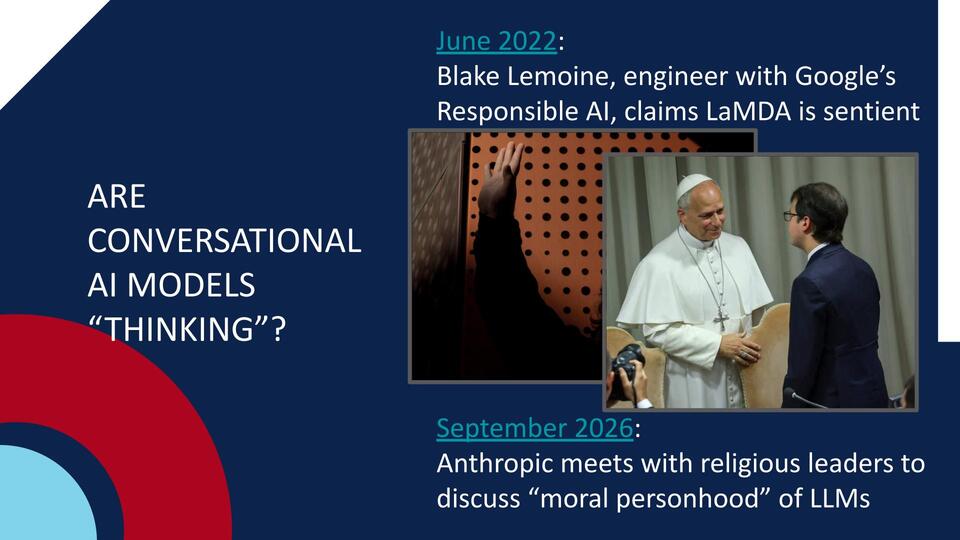
For this reason, I was thrilled when I recently had the chance to speak to the Saddlebrooke Freethinkers about the fundamentals of AI, laying out what we need to understand to tackle the question of whether these impressive-sounding LLM-based models are truly thinking in the way humans do, and conscious in the way people are. This question seems to be motivating a lot of people recently, as seen by Anthropic’s recent engagement with religious thinkers.
In order to address this question, though, we need to become aware of the very human bias that equates “language” with “thought.” These two things are not the same. You may have missed my recent talk, but you can find my slides at
https://sbfreethinkers.wordpress.com/events/past-events/
Thank you to Ginny Healy for the connection, Barbara Starrett for the invitation, and all the Freethinkers for a stimulating question and answer session.
Enjoy Reading This Article?
Here are some more articles you might like to read next: